Measuring causal strengths from spatial cross-sectional data with geographical cross mapping cardinality
Abstract
Spatial cross-sectional data encapsulate rich information on spatial processes, forming a critical foundation for examining causation between variables. Detecting and quantifying such causation is essential for understanding complex natural and human phenomena. Measuring causal strengths from spatial cross-sectional data, however, remains challenging, as existing methods often suffer from high false positive rates when quantifying causation. To address this gap, we propose a Geographical Cross Mapping Cardinality (GCMC) model that quantifies causal strength based on the intersectional cardinality of neighborhoods in reconstructed state space, and incorporates the DeLong placement method to evaluate the statistical significance of causal strength estimates. We validate GCMC using a simulated three-variable causal benchmark and three representative spatial cross-sectional datasets with known causal structures, and further assess its sensitivity to observational noise. Results demonstrate that GCMC effectively captures causation across weak, moderate, and strong coupling regimes while maintaining a low false positive rate and robust performance under noise. As a new extension of empirical dynamic modeling for spatial cross-sectional data, GCMC complements existing methods and enables more reliable spatial causal inference.
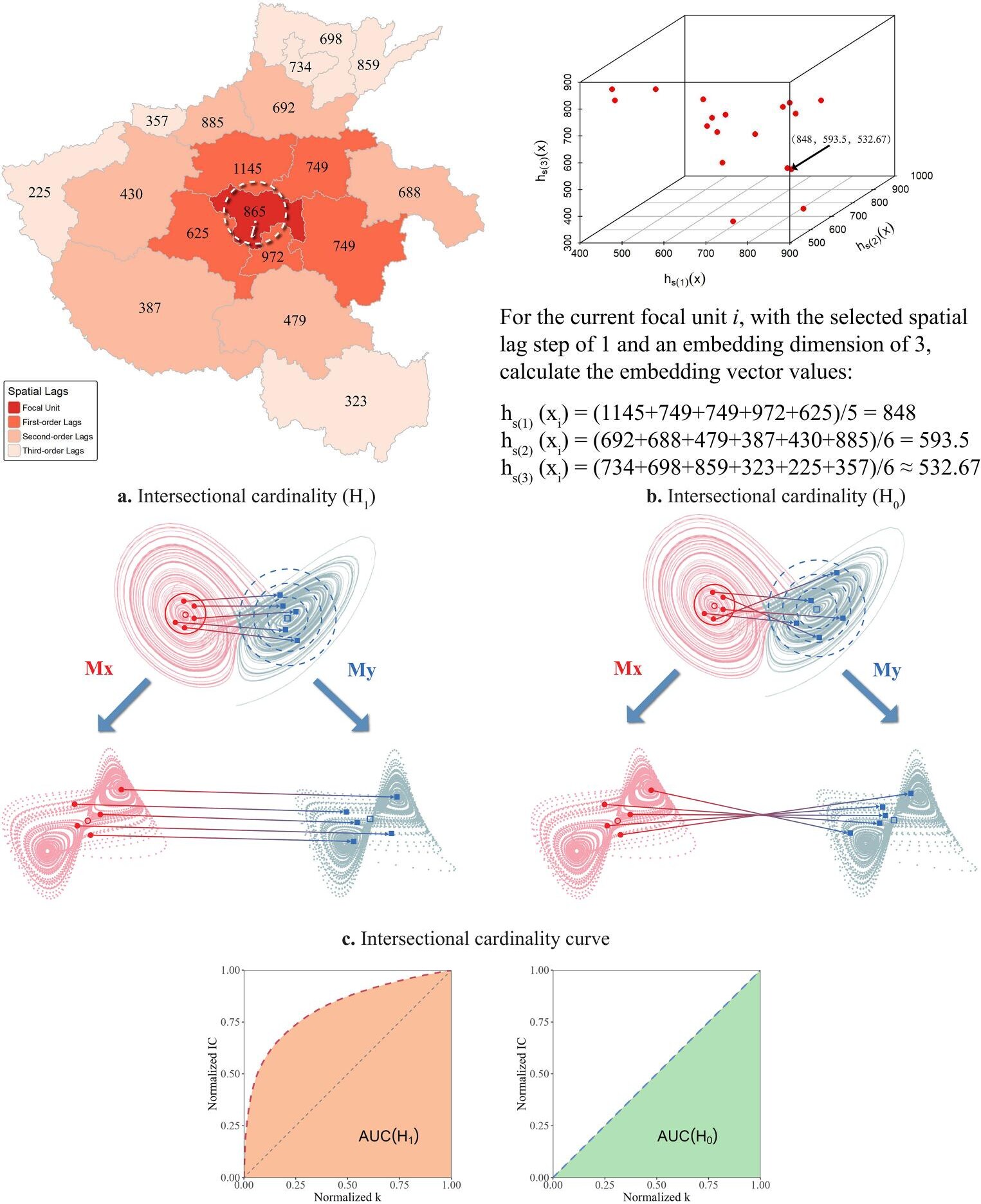
Figure 1. Demonstration of reconstructing embedding for spatial cross-sectional data (top) and schematic diagram of cross mapping in GCMC with the resulting intersectional cardinality (bottom).