Understanding multi-perspective urban green space patterns under urban expansion: Evidence from Guangzhou
Abstract
Urban expansion, a defining process of global urbanization, has profound implications for the distribution and quality of urban green spaces (UGS). This process is often accompanied by competition for land resources between elements of urban morphology and UGS, which in turn can negatively affect ecological sustainability and human well-being. Despite extensive research on the effects of urban growth on UGS, there remains a lack of multi-perspective analyses that integrate both aerial and human-centric perspectives of UGS indicators. Moreover, there is a lack of spatial association analyses between UGS and urban morphology. This study addresses this gap by introducing an innovative methodological framework integrating aerial perspective (Normalized Difference Vegetation Index, NDVI) and human-centric perspective (Green View Index, GVI), urban morphological indicators encompassing building density (BD), road density (RD), and land use mix (LandUSE), as well as socioeconomic housing price (HP) and topographic digital elevation (DE) indicators. This framework is employed to examine the evolving spatial relationships between UGS and urban morphology during different phases of urban expansion in Guangzhou, China. Using high-resolution satellite and street view data, as well as urban morphological data, we reveal that: (1) Significant spatial differences among various UGS metrics, which highlights the necessity of employing a comprehensive multi-perspective metrics approach; (2) UGS and urban morphology typically reflect the trade-offs between built-up growth and green space provision during urban expansion; (3) These relationships are further modulated by land development, urban design, local topography, and planning policies, leading to considerable variation along different urban expansion axes and time periods. Our findings advance the understanding of how urban expansion shapes the dynamics of UGS and provide critical evidence to inform sustainable urban planning and policy-making in rapidly growing cities.
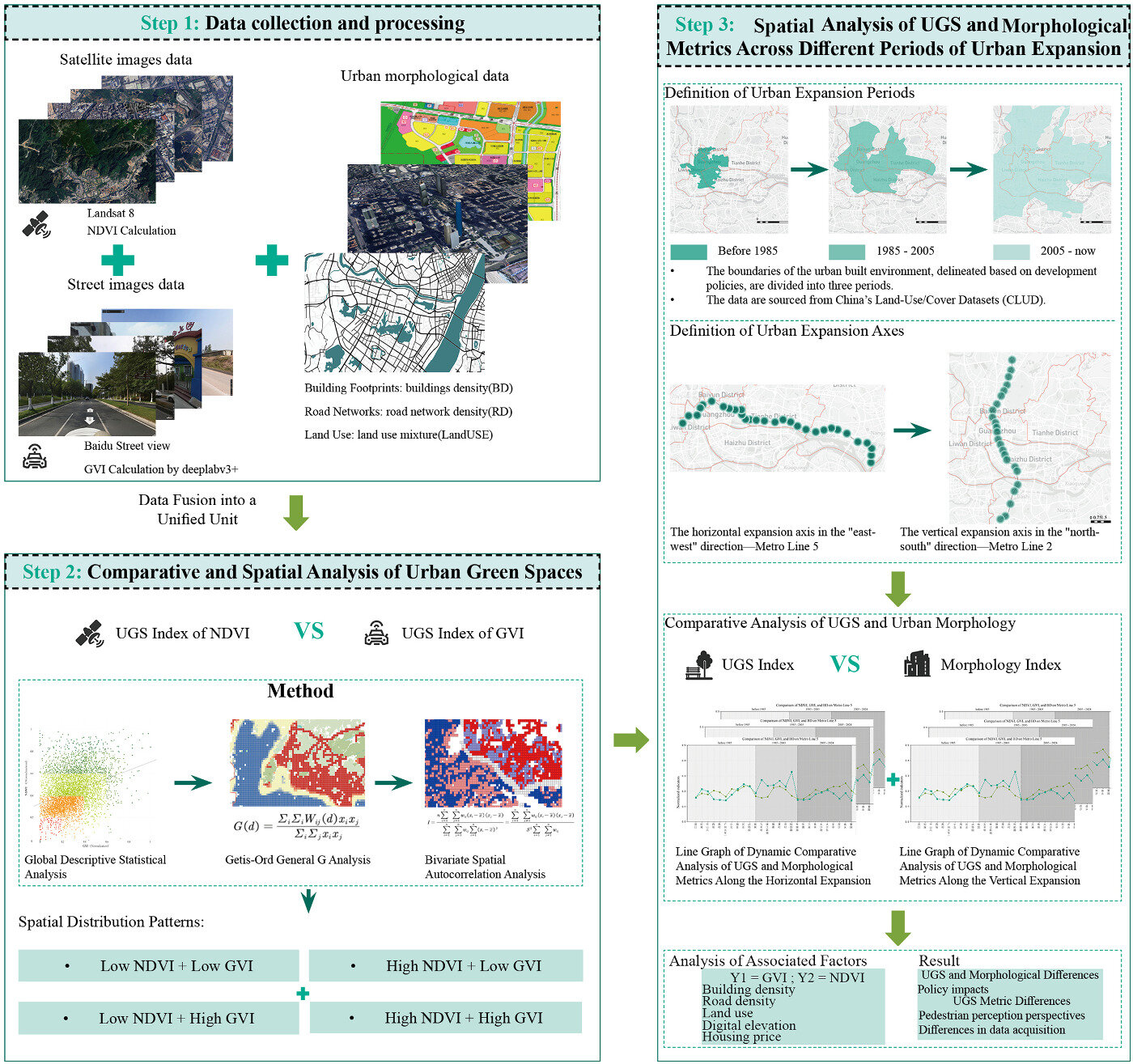
Figure 1. Research framework.